

Measure substrate flatness and resolve preparation requirements
Flatness, alignment, and architectural scale
Large-Format Tile
Large-format tile and porcelain slab installation for showers, floors, fireplace surrounds, and architectural walls where flatness, lippage control, and layout precision are visible from across the room.
Request a Quote
Large-format tile gives a room architectural scale. Fewer grout lines, longer sightlines, a surface that reads as a plane rather than a grid. It only works when the preparation and layout are disciplined, because a big tile has nowhere to hide a bad substrate.
Why size changes everything
A 12 by 12 tile follows the floor. If the substrate dips two millimetres over a metre, the small tile rides down into the dip and back out, and nobody notices. A 24 by 48 tile bridges the dip. One corner sits high, its neighbour sits low, and you feel the edge with your foot and see it in the light every day. That edge is lippage, and it’s the reason large-format work starts with a straightedge, not a trowel.
Industry flatness standards for large tile are tight: roughly three millimetres over three metres. Most subfloors and walls in the Lower Mainland are nowhere near that. We measure, then we level with self-leveller, a mortar bed, or shimming and a new substrate on walls, until the surface is ready for the tile going on it.
Handling and setting
Large tile needs full mortar coverage or it cracks under load, so we back-butter every piece and use a large-format thinset that holds its ridge. Porcelain slab panels, the 1.2 by 2.4 metre sheets and larger, are cut on a rail system, moved with suction frames, and set by two people. A slab wall is measured, templated and cut before the adhesive is mixed, because there’s no adjusting a panel once it’s up. Leveling clips hold the edges flush while the mortar cures; we use them on every large-format floor and wall.
Layout at scale
With large tile the layout is visible from the doorway. We start at the longest sightline and the most-seen wall, position the grid so full tiles land where you look and cuts hide where you don’t, and align the joints through doorways and around the room. On a slab wall the question is where the one or two seams go. Behind the glass, at an inside corner, centred on the wall so it reads as a design line. Bookmatched porcelain, with the veining mirrored across the seam, is the top end of this work and lives on our custom tile installation page.
Showers and wet rooms in large-format
Big tile on shower walls gives that continuous, hotel-quiet surface, and it makes the waterproofing more important, not less, because there are fewer joints to give a leak away. We build large-format showers on a Schluter membrane over a substrate flattened for the tile size, plan the niche edges to land on joints, and mitre the corners. Large tile on a shower floor only works with a linear drain and a single-plane slope; with a centre drain the floor has to be cut into a pattern or done in mosaic. Our Calacatta wet room and large-format gray bathroom show both the walls and the floors done at this scale.
Floors, fireplaces, and walls
Large-format porcelain floors run continuous across open plans, and the flatness work described on our floor tile page is what makes that possible. Movement joints still go where the floor changes direction or runs long. Fireplace surrounds in slab, with mitred returns, are one of the best uses of the material: a single vertical plane of stone-look porcelain that no small tile can imitate. Feature walls, kitchen range walls and slab backsplashes round it out.
Porcelain slab versus natural stone
Porcelain slab gives the look of marble or travertine with none of the sealing, staining or etching. Natural stone gives depth and variation porcelain can’t quite match, and asks for care. Both are installed to the same flatness standard, and the choice is about how you live, not how it photographs. Our natural stone page covers what real stone asks of you.
Across the region
Large-format work follows the newer housing: hillside builds in West Vancouver and North Vancouver, rebuilds in Richmond, new construction in Surrey and Langley. Older homes in Vancouver and Burnaby can take it too, with more preparation. We’ll measure the room and tell you honestly what it needs.
Send a photo of the space and the tile or slab you’re considering. Request a quote and we’ll start with the flatness.
Highlights
Designed around the finished surface and the assembly beneath it.
- Substrate flatness measured and corrected before installation
- Layout planned around slabs, grout lines, and focal walls
- Porcelain slab panels handled, cut, and set as a two-person job
- Lippage control and clean transitions prioritized
Process
How the work is handled.
Plan cuts, transitions, movement joints, and visual alignment
Set with format-appropriate materials, coverage, and handling
FAQ
Useful questions before work begins.
Is large-format tile harder to install?
Yes. Larger tile makes substrate preparation, layout, handling, and lippage control more important. The tile hides nothing.
Can large-format tile reduce grout lines?
Yes. Fewer grout lines give a cleaner, more continuous surface, but flatness and lippage control have to be precise to pull it off.
What counts as large-format?
Anything with a side over about 15 inches, so 12 by 24 and up. Porcelain slab panels at 1.2 by 2.4 metres or larger are the top end and need their own handling.
Can you install porcelain slab in a shower?
Yes. Slab showers need a flat, waterproofed substrate, a plan for where the one or two seams land, and mitred edges at niches and corners. It's some of our most requested custom work.
Related work
Finished installs in the same discipline.
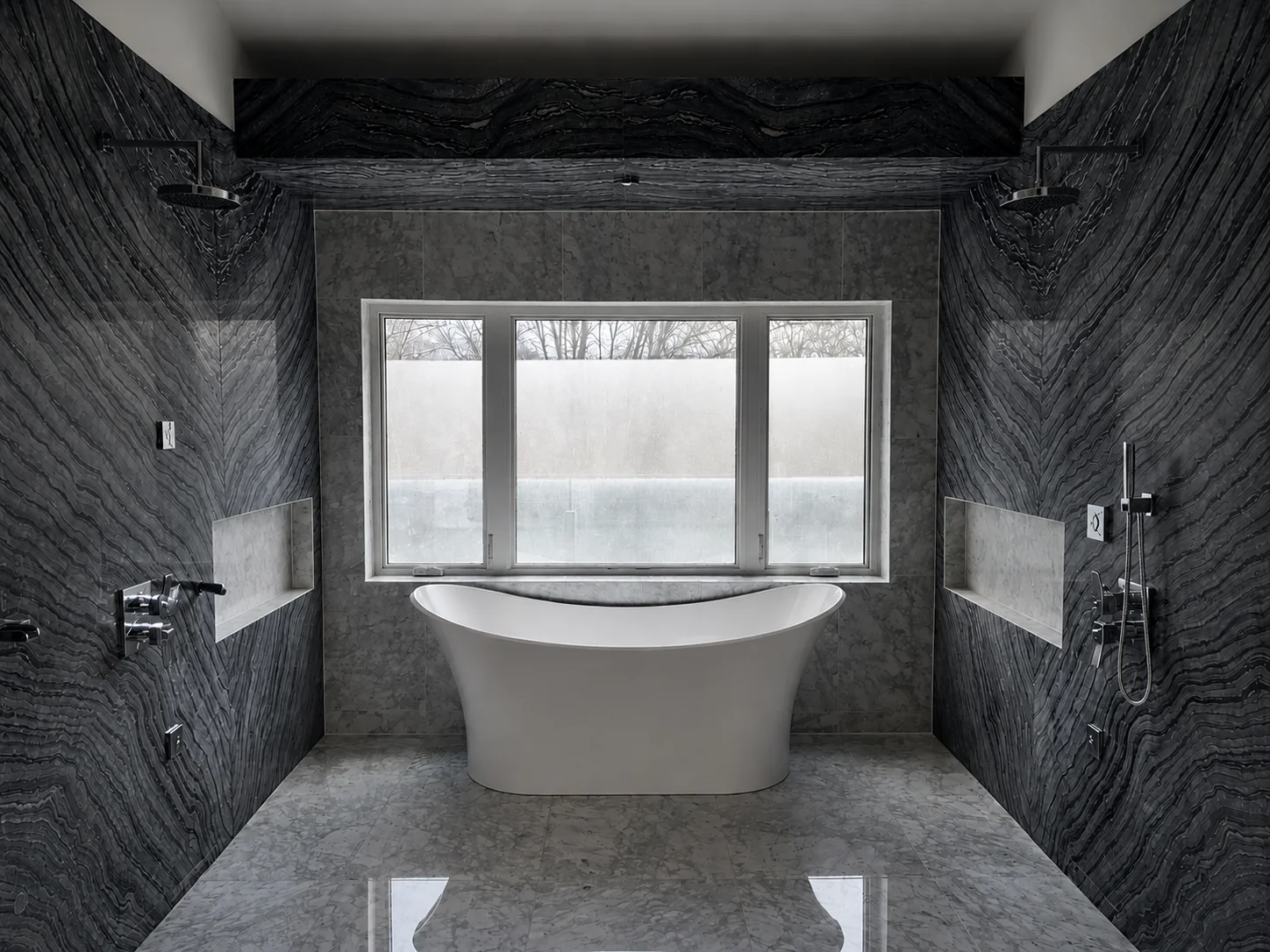
Burnaby
Bookmatched Dark Wet Room
Bookmatched dark stone wet room walls, freestanding tub, niche alignment, and polished floor transitions.
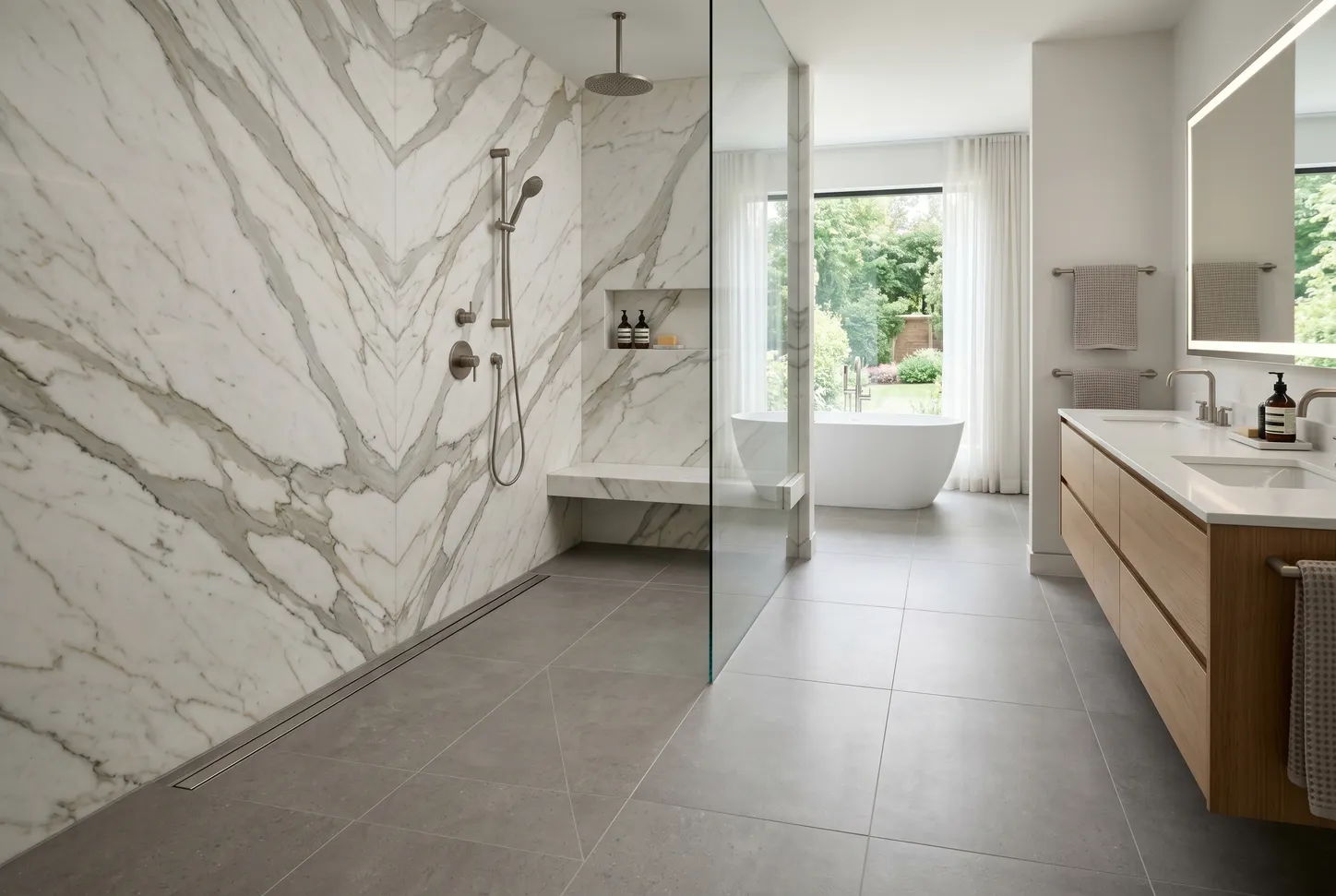
North Vancouver
Calacatta Wet Room
Curbless wet room with bookmatched Calacatta marble shower walls, a floating marble bench, a fully tiled linear-drain floor, and large-format porcelain throughout.
Service areas
Large-Format Tile across Greater Vancouver & the Fraser Valley.
Ready for a site visit?